By Jake Buvala | Last updated: January 18, 2026 | Originally published: April 2011
Dear puppy parent,
So you’ve adopted a puppy who has turned out to be a little terror, and you’re thinking of finding them a new home. Despite your best efforts, some problem has come up. Maybe they:
- Won’t stop biting
- Freak out in their crate or pen
- Are terrible at walking on leash
- Try to eat all the rocks, trash, and assorted other horrors on the street
- Won’t stop pooping all over your house
- Terrorize your children and your other pets
Or maybe they just require a lot more work than you expected.
I feel your pain. This letter is not a guilt trip; I’m sure you’ve heard the “OMG how could you! A dog is a lifetime commitment!” lecture already. That kind of thing doesn’t help, and you will find none of that here.
This is just some friendly advice from someone who’s been there.
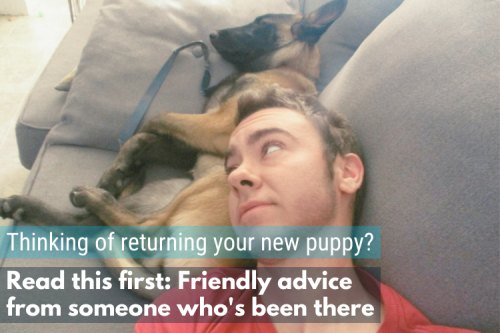
I’d like to introduce you to my puppy, Friday.

I had waited my whole life for this moment. And now that it was here, I wished I could undo it
I had dreamed about getting a dog for as long as I can remember. I read all the books. Spent hours researching online. I learned to handle dogs by helping my friends with theirs.
If ANYONE was ready for a puppy, it was ME.
Finally, the day arrived. It was time to start visiting animal shelters to pick out my puppy.
We found her on the first day of our search.
An eight-week old German shepherd mix, tucked away in the last kennel. Clumsily chewing her toes, she lost her balance and rolled onto her back. She was an adorable goofball. She was everything I wanted.
Then we took her home.
Friday was the puppy from hell, as far as I was concerned.
She would bite, tear at clothing and chew on everything. She never listened. She had an attention span of three seconds. She whined all night long. She peed on my bed. She didn’t seem to like me much.
The feeling was mutual.
I thought I’d somehow ended up with the worst puppy in the world.
I was deeply discouraged. This was not at all what I imagined this would be like. I was sick of the whole thing and I just wanted my life to go back to normal.
Sound familiar?
That feeling when you have no life beyond your puppy and you regret every decision you made to get to this point
You might be dealing with challenges like:
- Being unable to leave the room for two seconds without the puppy screaming her head off or having an accident
- Feeling like you spend 90% of your time saying “no, don’t do that!” (And you don’t know why you bother, because the little hell-spawn never listens to you, anyway)
- Having to choose between spending time with your kids/older pets or the puppy, because the puppy terrorizes them (complicated even further by the fact that you can’t leave the puppy alone because they scream their head off when you do)
The biting thing was the biggest issue with Friday. She bit me. Bit my friends. Bit my little sisters (my mom was especially not thrilled about that one).
Maybe you’ve tried teaching your pup manners, but it hasn’t worked.
Maybe you’re worried you’ve made too many mistakes, and now it’s too late.
Maybe you regret putting your family through this stress. The tension in your household has skyrocketed and you feel like you’re one more argument with your spouse away from taking the puppy back to the breeder.
No matter what you’re experiencing, one thing is for sure:
You knew raising a puppy would be a challenge, but you were not prepared for THIS
You’re probably thinking, “dog ownership is supposed to be fun! What gives? Do I have a bad puppy? Am I a bad person?”
You’re not a bad person. Neither is your puppy, as unbelievable as that may sound right now.
Why is this so hard??
Getting a puppy disrupts every part of your life. If there’s one thing the human brain hates above all, it’s being disrupted.
The needy little fuzzball requires constant attention. You don’t get much sleep. Your free time evaporates.
You want to make sure you do this right, but an internet full of conflicting advice has you second-guessing your every move.
Add your pup’s obnoxious behavior to this mix of self-doubt and sleep-deprivation, and you have the recipe for something we like to call:
The “What The **** Was I Thinking?!” phase (WTFWIT)
I’ve also heard people call it the “puppy blues” in recent years. Which is cute, but it doesn’t capture the true essence of the experience. The feeling isn’t “well, golly! I’m a little blue today.”
It’s “oh god, what the FUCK WAS I THINKING.”
It usually starts 3-14 days post-adoption.
But the doubts can begin as early as day one.
After all this chaos, your brain is trying to slam the reset button and go back to its familiar routines. This is why you’ve found yourself tempted to get rid of the dog, even though you never thought you’d be the kind of person who would get rid of their dog.
The WTFWIT phase is normal.
Now, don’t get me wrong – I’m not brushing off your struggles. And I’m not saying that time will magically fix your puppy’s behavior issues or get them to listen to you.
But those behavior issues are (relatively) easy to deal with when you have the right guidance. We help people fix them all day every day. We could do it in our sleep at this point.
The hardest part is dealing with the monsters in your head
The monsters that whisper:
You’re screwing this up.
Something’s wrong with your puppy.
It’s too late.
This was a mistake.
The monsters make it impossible to think straight, right? You’ve been frantically googling, getting more overwhelmed the more you scroll, feeling more hopeless with every random training tip that just makes your puppy more obnoxious.
Notice how I haven’t said a single word about how to actually handle Sparky’s behavior issues in this letter?
That’s on purpose.
Because all the dog training advice in the world is useless if you don’t believe things can get better.
So let’s talk about that.
“Okay, maybe there’s hope for puppies like mine,” your brain concedes. “But I’m afraid it’s too late for us. Everything’s gone wrong. Sparky’s learned too many bad habits and we’ve missed our chance at the dream.”
Oh boy – I really, REALLY get this fear. And not just for dog-related stuff; there have been a couple times in my life where I was incredibly excited for some upcoming big life change. I daydreamed about how amazing it would be…
Only to be devastated when everything went wrong and the dream turned into a nightmare. It felt so awful in the moment that I couldn’t imagine how it could ever lead to happiness.
But it did, in the end.
I learned that the path can look wildly different than the one you imagined, and still get you where you want to go.
Is there a mourning period when reality doesn’t match the fantasy? Absolutely. I think it’s fair to grieve for the way things “should” have been.
But none of that means you’ve missed your shot. Some of the strongest bonds I’ve ever seen between humans and dogs came from rocky starts:
She arrived at our first training session in tears. She’d hit the end of her rope with her puppy… and snapped.
“Jane” had adopted “Sparky” two weeks earlier. Sparky was a bitey little whirlwind of a puppy. He peed everywhere, chewed everything, escaped his pen, and cried whenever he was left alone.
That last one was, to Jane’s surprise, the hardest part. It made her feel trapped in her own home. Her head was a mess of frustration, guilt, and shame.
Frustration because Sparky just. Wouldn’t. CALM. DOWN.
Guilt because she knew he was just a baby; he wasn’t doing any of this at her.
Shame because that morning, she snapped. She’d given Sparky a harsh physical correction – and immediately felt terrible.
Jane cried on our Zoom consult as she described the many things that had gone wrong. She was certain the relationship was too damaged to recover from such a rough beginning.
As we talked, I identified a few ways that her puppy-raising approach was making things harder than they needed to be.
Jane’s situation was one we see with most struggling puppy owners: the double whammy:
- They’re dealing with the mental side of the WTFWIT phase. The monsters in their head. Their brain trying to drag them back to familiar territory. Etc.
- Aaaand technically yes, they’re doing some things “wrong.”
This is why you gotta be careful with common puppy blues advice like “just give it time. It gets better!”
If Jane had continued doing what she was doing with Sparky, things would not have gotten better.
So we taught her what to do differently.
(I won’t get into the specifics, since those will be different for everyone)
A year after she finished the program, Jane contacted us again. This time asking for advice for tricks she could teach Sparky. He had grown into such a phenomenal dog and their bond was so solid she wanted to take on fun challenges together!
You haven’t missed your chance.
You’re just in the “WOW WHAT A DISASTER” part of the story before the redemption arc unfolds.
How long is the WTFWIT phase supposed to last?
Just long enough for your brain to adjust and your dog to begin to settle in.
If things are going well, the worst of it should be over by Week 3. We’ve even seen people come out the other side in just a few days once they get the right support.
If you’re dealing with extra challenges (preexisting mental health stuff, grief from losing a previous pet, raising a puppy with health issues, raising a fearful rescue dog, etc) it can take longer.
But to be clear: even with those challenges, you shouldn’t be struggling and losing your mind for months. The more complicated the situation, the more important it is to seek professional guidance as soon as you can.
If things are getting worse, or…
- You constantly have to correct your puppy or take stolen objects away from them
- They’re growling at you or developing aggression issues
- The biting is relentless
- You lowkey feel like they actually hate you
- You’re not having any luck with potty training
- Everything, from walks to training sessions, feels like an uphill battle
- You’ve tried all the usual advice, but nothing helps
That’s not normal WTFWIT brain stuff. Those are usually signs that the approach you’re using is making things harder than necessary and creating bigger problems.
That was the case with Friday and me.
I thought she was being stubborn and dominant.
Now I know that she was struggling as much as I was.
Turns out, all her really irritating behaviors were classic examples of a confused baby animal dealing with a stressful situation the only way she knew how.
She wasn’t fighting me. She needed help.
I wish I could go back in time and tell myself that.
See also: Is “give it time” really the solution to the puppy blues?
You’ll know you’ve found the right approach when you reach…
The “We Can Do This!” phase
The part where the sun breaks through the clouds and the angels sing. You’re no longer tempted to ask the breeder/rescue to take the demon child back. You’re getting the hang of things.
The biting becomes manageable. They start listening more.
You might even be having… fun??
It’s not that the puppy becomes perfect overnight, but you’re not drowning anymore. You and Sparky are a becoming a solid team, ready to slay life’s dragons together.
What if you’re seriously considering returning your puppy?
Let’s take the shame out of this real quick:
You’re not a bad person for considering this. Sleep deprivation and constant overstimulation will do that to ya.
And sometimes, rehoming is the right choice. The honorable choice, even.
We’ve worked with a few amazing students who tried their best, but ultimately determined that they were not a good match for their puppies, and had to make the tough decision to find them a better home.
That’s okay.
But the problem is that it’s a really hard call to make when your brain has got you feeling like a trapped squirrel being hunted by a bear.
Our advice:
Before you make a such a big decision in fight-or-flight mode, give yourself the chance to try something different.
Give it another week or two. Enough time to take a breath and let the ol’ nervous system chill out. And – most importantly – get some help instead of trying to figure all this out yourself.
The right dog behavior professional can get you on the right track and help you figure out if your situation is actually as impossible as the obnoxious little brain monsters are telling you.
And then if you decide that rehoming is the best option, you can feel good knowing you made that choice with a clear head, not out of desperation.
(We can be that professional help, if you want. No matter where you are in the world. We built Puppy Survival School for people in your position)
These days, it’s nearly impossible to imagine that the dog I loved so dearly was, at one point, the puppy I thought I hated

Friday lived to be eleven years old. She was the sweetest dog you’d ever meet.
All the puppyhood nonsense that made me so angry is now a very distant memory. A memory that I can laugh at… mostly. Since we’re being honest, it wasn’t a total “and then they lived happily ever after!” story.
I made a lot of mistakes with her. Mistakes that affected our relationship and her behavior for years. She’s a big reason I became a dog trainer: to turn these regrets into something useful (see below).
Still, my point stands: no matter how all-encompassing the puppy nonsense feels when you’re in the thick of it, it’s a short chapter in the story of your life together.
Puppyhood is a wild time. But it doesn’t last very long and most of us miss it when it’s over.
I believe in you. You can do this – and you don’t have to do it alone.
Hang in there.
-Jake
(Who, for some reason, voluntarily adopted five more puppies after Friday)